
Pendant lights are light fittings that hang down from the ceiling on a rod, chain, or cord. Unlike recessed ceiling lights, which sit flush overhead, pendant lights drop into the room and become part of the design.
They can make a kitchen appear finished, functional and intentional, if they are the right choice. In some kitchens, they create a strong focal point and improve task lighting. In others, they interrupt sightlines, make the room feel busier, or don’t suit the layout.
If you are deciding whether to hang pendant lights over a kitchen counter or island, the best approach is to look at both function and style. You want them to look good, but also to suit the size of the counter, the ceiling height, the overall kitchen style, and how you use the space daily.
When pendant lights work well
People use pendant lights in kitchens for a few main reasons:
- Provides focused light over a work surface
- Helps define the island or counter as a separate zone
- Adds shape, texture, or contrast to the room.
Pendant lights work best when they solve both a practical and a visual need.
From a practical point of view, they are useful over counters and islands that are used for prep work, casual dining, homework, or entertaining. A pendant brings light lower than a ceiling downlight, which can make the surface feel brighter and more defined. This is especially helpful if the island is large or if the kitchen has a high ceiling.
They also work well when the island is a major feature of the room. If the counter sits in the centre of an open plan kitchen, pendant lights mark the space and makes it feel intentional. In larger kitchens, this can stop the island from looking out of place.
From a design perspective, pendant lights pair well in kitchens with enough visual space to support them, such as:
- a reasonably large island
- ceiling height that allows the lights to hang comfortably
- open sightlines where the pendants can be appreciated
Pendant lights tend to work better in some kitchen styles than others. Here are a few of them.
Modern kitchens
In modern kitchens, pendant lights usually work best when the shape is clean and the detailing is restrained. Think simple cylinders, domes, discs, or slimline linear forms. They pair well with flat panel cabinetry, handleless joinery, waterfall benchtops, and minimal splashbacks because they continue the clean, architectural look without adding clutter.
Contemporary kitchens
Contemporary kitchens can handle more sculptural pendants because the style often mixes clean lines with softer materials and layered finishes. This is where you might see glass pendants, curved forms, mixed metals, or statement lighting used to create a focal point. They work well when the kitchen has balanced contrast, for example warm timber, stone, and matte finishes.
Industrial kitchens
Pendant lights suit industrial kitchens very well because exposed materials are part of the style. Metal shades, darker finishes, and heavier silhouettes fit this style. They pair naturally with darker cabinetry, concrete surfaces, exposed shelving, black tapware, and textured finishes.
Farmhouse kitchens
In farmhouse or country inspired kitchens, pendants can add warmth and character. They often work best when the shape feels relaxed. This might mean lantern styles, enamel style shades, aged metal finishes, or softer glass forms. They suit shaker cabinetry, timber details and warmer paint colors.
When pendant lights do not work well
Pendant lights are not automatically the best option just because there’s an island in a kitchen. Sometimes they create more problems than benefits.
They may not work well in small and visually busy kitchens. If you have upper cabinets, like the ones from WA Prestige, strong splashback patterns, feature stone, open shelving, and decorative hardware, adding pendants can push the room too far. In these cases, recessed lighting might work better at keeping the space feeling calmer.
They can be a poor fit where sightlines matter. In a compact open plan room, hanging pendants too low can interrupt views across the kitchen and make the space feel crowded. This is especially noticeable if the lights sit between the kitchen and living area.
Low ceilings don’t work well with pendant lights. If the ceiling is not high enough to let the pendants hang with proper clearance, they can feel intrusive rather than elegant. Here, a flush mount light or recessed downlights will make more sense.
Small or narrow kitchen islands make pendant light look oversized and out of proportion. Sometimes one statement pendant works, but often the better decision is to keep the ceiling simple.
Different materials and styles used for pendant lights
The material and style of the pendant effect both the appearance of the kitchen and the quality of light. Some pendants feel crisp and architectural, while others feel soft, textural, or rustic. It is important to choose a type that fits the style of the kitchen, rather than selecting a light in isolation.
Modern pendants
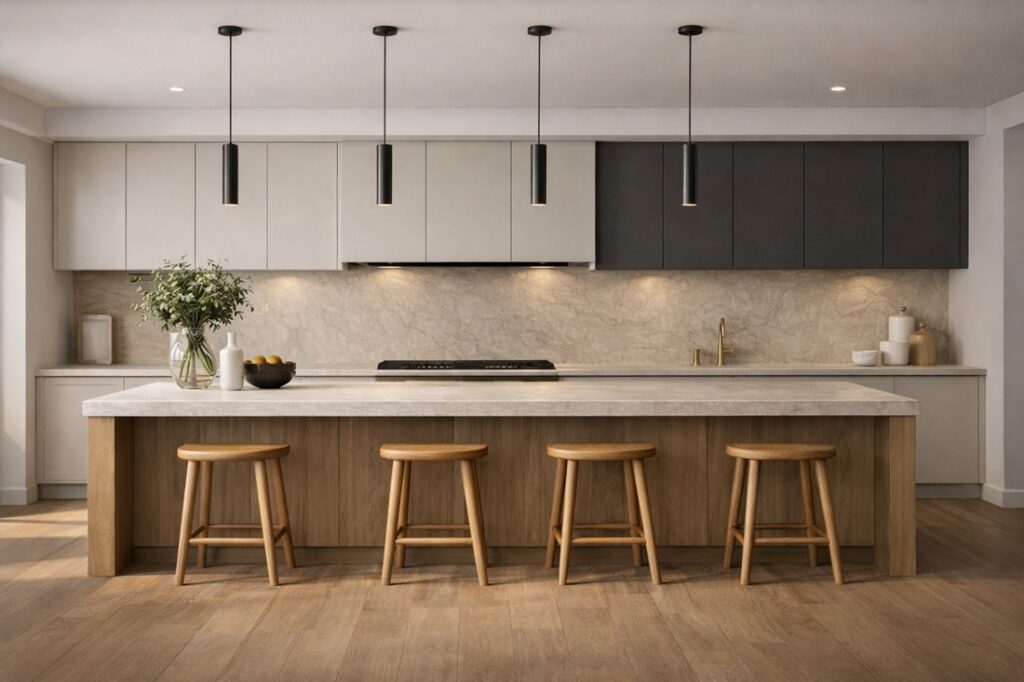
Modern pendant lights have simple geometry and little decorative detail. They are often made from metal, glass, or smooth composite materials. Matte finishes are common. These lights work well in kitchens with flat cabinet fronts, clean lines and integrated appliances. If your kitchen is minimal and you want the lighting to feel sharp and current, modern pendants are often the best fit.
Contemporary pendants
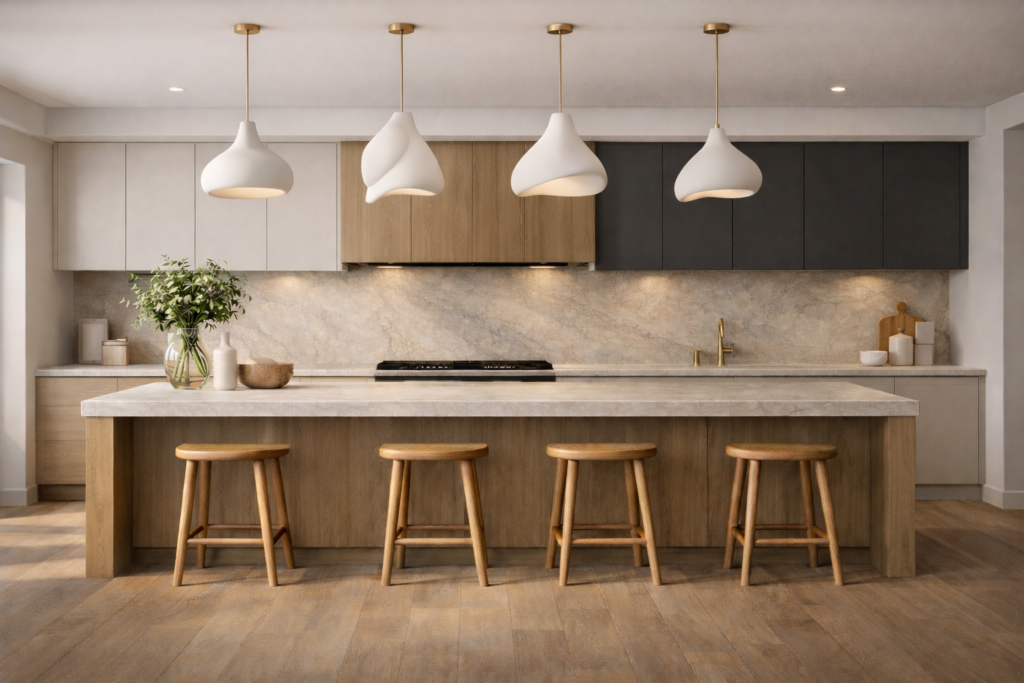
Contemporary pendants are a little broader in style. They often combine clean lines with softer shapes, tinted glass, mixed finishes, or more sculptural forms. They suit kitchens that feel current but not strict. If your kitchen uses natural stone, curved stools, brushed brass, or warm timber, contemporary pendants can tie those elements together nicely.
Industrial pendants
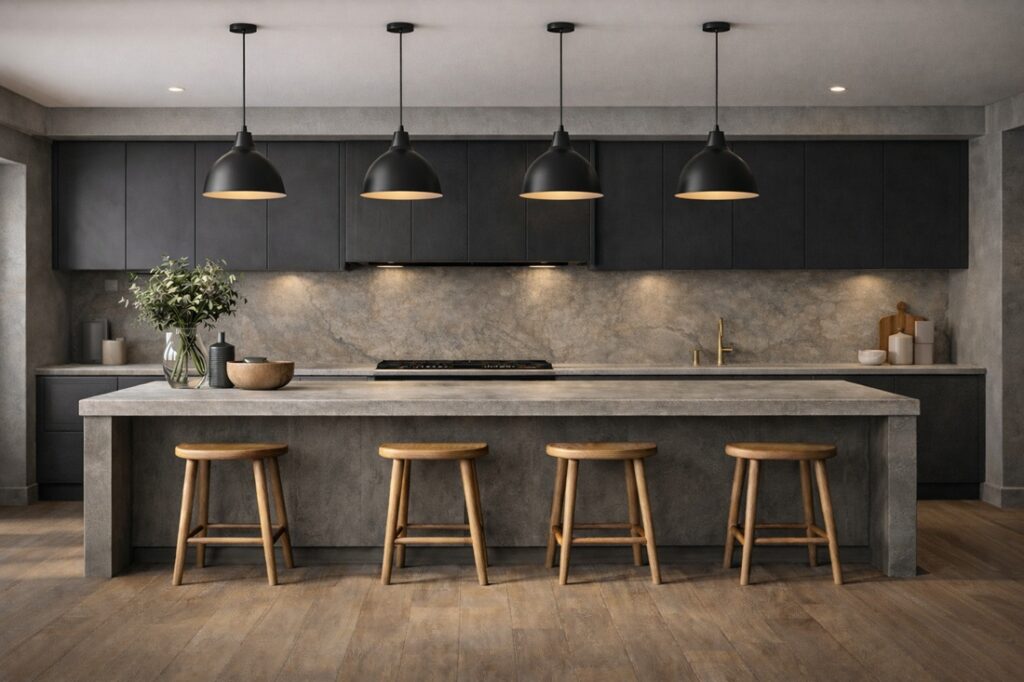
Industrial pendants are typically made from metal, often in black, charcoal, bronze, or weathered finishes. They tend to have a heavier shape and visible hardware. They work best when there are other industrial cues in the kitchen, such as darker joinery, black framed windows, metal accents, concrete surfaces, or exposed textures. In a classic kitchen, they can feel too harsh unless carefully balanced.
Rattan pendants

Rattan pendants bring texture and a casual, relaxed feel. They work well in coastal, organic, or warmer contemporary kitchens, especially where there are timber stools, natural fibres, or earthy finishes. The main thing to consider with rattan is scale and visual weight. A large woven pendant can be beautiful, but in the wrong kitchen it can feel too informal or too bulky. The light quality is also different as it gives a softer, more filtered light.
Glass pendants

Glass pendants are popular because they feel light and do not block sightlines as much as solid materials. This makes them useful in smaller kitchens or open plan spaces where you want pendant lighting without visual heaviness. Clear glass feels crisp and classic, frosted glass softens the effect, and tinted glass adds mood. One thing to consider is that clear glass can reveal the bulb more directly, so the bulb choice and brightness matter.
Lantern pendants
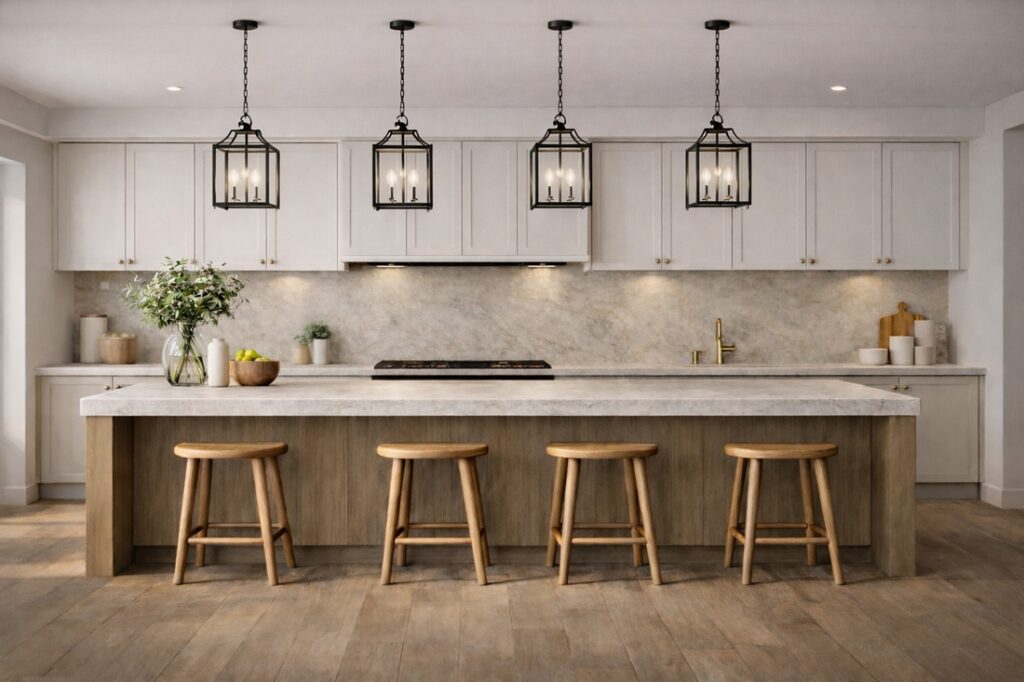
Lantern pendants have an open framed shape and often feel more classic. They can work well in farmhouse, Hamptons, and traditional kitchens that mix classic elements with clean lines. Because they have a more noticeable structure, they usually suit larger islands and higher ceilings.
What about colour?

Colour matters more than people think. The right pendant colour can help the lights blend into the kitchen or stand out as a feature. The best choice depends on overall kitchen design and mood.
Black pendant lights
Black pendants are versatile and work well when you want contrast.
- Suits modern, industrial, and contemporary kitchens
- Pairs well with black handles, tapware, and window frames
- Creates a strong focal point in light kitchens
- Can work in darker kitchens, but stands out less
Gold pendant lights
Gold pendants add warmth and an elevated feel.
- Works well with warm whites, green cabinetry, timber, and natural stone
- Suit contemporary, transitional, and classic kitchens
White pendant lights
White pendants are a safe choice when you want the lighting to feel soft and integrated.
- Suits Scandinavian, minimalist, coastal, and neutral kitchens
- Helps keep the kitchen feeling light and airy
- Less likely to dominate the space visually
Copper pendant lights
Copper pendants bring warmth, character, and a stronger design statement.
- Suits industrial and rustic kitchens
- Pairs well with warm timber, earthy tones, brick, and darker finishes
- Works best when the warm metal tone is repeated elsewhere
- May feel out of place in minimal kitchens
Red pendant lights
Red pendants are bold and expressive.
- Suits retro inspired, eclectic, or playful interiors
- Creates a strong focal point very quickly
How many pendant lights over a kitchen island?
One of the most common questions is whether to use two pendants or three. The answer depends on the length of the island, the size of the pendants, and how much visual impact you want.
2 pendant lights over a kitchen island
Two pendants are often the better option for medium sized islands. They create balance without overcrowding the space and tend to feel calmer and more spacious. If the pendants are larger or visually heavy, two is often enough. As a general guide, many people find that two pendants suit islands around 1.8 to 2.4 metres.
3 pendant lights over a kitchen island
Three pendants usually suit longer islands or kitchens where you want featured lighting. Three smaller pendants can spread light more evenly across the length of the benchtop. They work best on islands longer than 2.4 metres.
How to size pendant lights over a kitchen island

Sizing matters when choosing pendant lights for your kitchen. If too small, they often disappear in view. If too large, they can dominate the room and reduce visual openness.
A good starting point is to look at the island. The lights should feel proportionate to the island length and width, while leaving enough open space around them. The group of pendants should sit within the central portion of the island rather than stretching edge to edge.
- For many standard islands, pendants in the medium size range work well.
- If you are using two pendants, they can be larger.
- If you are using three, each one should be smaller.
- Large lantern or woven pendants often need more room visually even if not physical bigger, because they create more presence overhead.
Also think about visual weight, not just dimensions. Two similarly sized pendants can have very different effects depending on material and colour.
- A clear glass pendant may be physically large but still feel light.
- A black metal dome of the same diameter may feel much heavier.
If the island is narrow, avoid pendants that are too wide or too bulky, because they can overhang awkwardly in your field of view. If the island is small, a single statement pendant or a discreet pair may work better than trying to force a more dramatic arrangement.
What height should pendant lights be over a kitchen island?
Height just like sizing has a big impact on practicality and appearance.
If you hang pendants too high, they lose presence and lighting effectiveness.
If you hang them too low, they interrupt sightlines and feel intrusive.
A common guideline is to hang pendants so that the bottom of the fitting sits around 75 to 90 centimetres above the benchtop. In many kitchens, this gives enough clearance for views across the island while still bringing the light down into the space.
The exact height should still respond to the room.
- If you have high ceilings, hang them slightly higher while keeping the proportions right.
- If the pendants are visually large, a bit more clearance can stop them feeling heavy.
- If the fittings are small or transparent, they can sit a little lower without becoming obtrusive.
Should you hang pendant lights over your kitchen counter?
Pendant lights are a good idea when the counter or island is large enough, the ceiling height allows them to hang properly, and the kitchen design benefits from a feature overhead. They are especially effective when you want to define the island, improve task lighting, or add a design layer.
They may not be the right choice if the kitchen is small, the ceiling is low, the room already has a lot of visual detail. In those cases, simpler ceiling lighting may do the job better.
Want practical kitchen design advice from custom cabinet makers? Call WA Prestige today! 08 9498 1880