
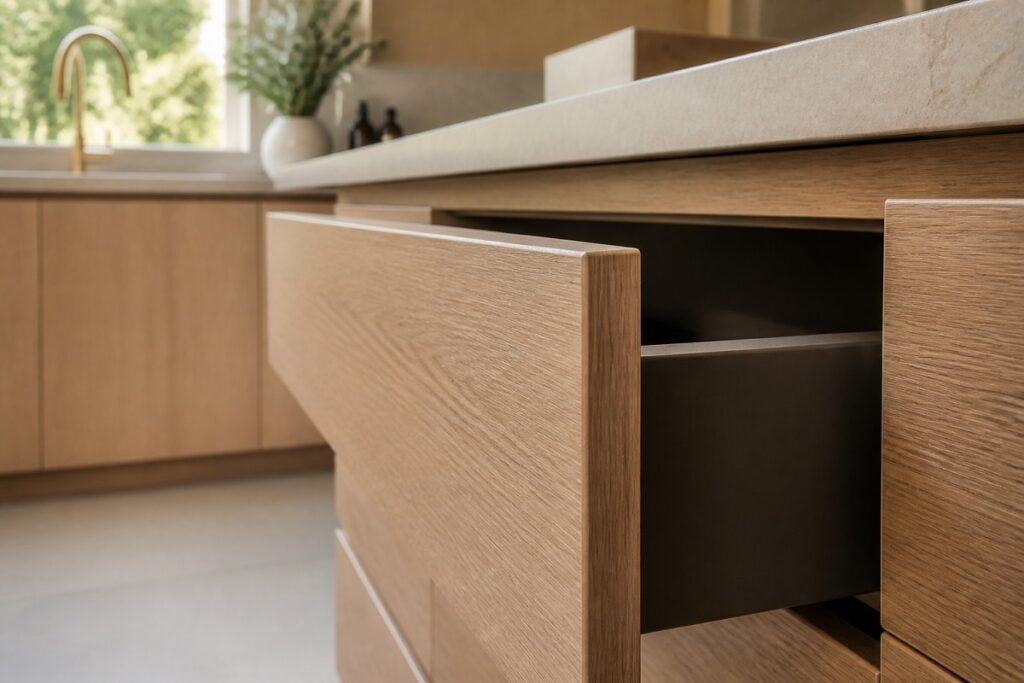
Cabinet edge banding is a thin strip applied to the exposed edges of board panels to conceal the raw core and give cabinetry a finished appearance. It is commonly used on melamine, laminate, MDF and particleboard panels, creating clean-looking edges while helping to protect them from everyday wear and tear.
What are the three types of edge banding?
In most Australian cabinetry, the three most common types are ABS, PVC and melamine.
- ABS edge banding is a durable plastic edging widely used on higher-quality cabinets.
- PVC edge banding is another plastic option valued for its versatility and wide colour range.
- Melamine edge banding is a thinner, paper-based option often used when budget is a priority.
These materials are common in board and edging systems from suppliers such as polytec, which refers to both ABS edge banding and melamine edging tape.
For most kitchen cabinets, ABS is usually the best all-round material. It provides a cleaner, more durable finish than thinner edging options and tends to last longer on frequently used doors and drawer fronts.
High-end or custom cabinetry often uses seamless or near-seamless ABS systems. For example, Laminex InvisiEdge is designed to create a less visible join while improving resistance to chipping, discoloration and delamination.
What is a good alternative to edge banding?
The best alternative is often solid timber edging, also called timber lipping. Instead of applying a thin manufactured strip, a real timber edge is fixed to the panel and finished as part of the joinery. This gives the edge more depth, allows for softer profiles and creates a premium feel. Keep in mind that it is usually more specialised and comes at a premium price.
Another good option is veneer edging, especially when the aim is to create a more natural timber look. Suppliers such as CPV offer multi-layer veneer edging for doors, drawer fronts, panels and benchtops.
What are the disadvantages of edge banding?
The main disadvantage is that edge banding is an applied finish rather than a solid edge. If the material is low quality, the colour match is poor or the installation is substandard, the join can become visible and the cabinet can look cheaper.
Lower-grade or poorly bonded edging can also chip or lift over time, especially in kitchens where heat, steam and frequent cleaning are part of daily use. This is one reason seamless edge systems have become more popular. As REHAU explains in its zero-joint edgeband guidance, traditional glue-based edging can be more susceptible to visible glue lines, inconsistent bonding and failure caused by heat or moisture over time.
Melamine edging has an additional weakness: it is thinner and less impact-resistant than ABS, so it is not always the best choice for visible, high-traffic kitchen surfaces.
Conclusion
Cabinet edge banding is a small detail, but it has a major impact on how your kitchen cabinets look and last. In most kitchens, it is best to choose an edging material that suits the board and the level of wear the cabinet will experience. For everyday kitchen use, ABS is usually the best option. For a more premium finish, consider solid timber or veneer edging.
If you’re planning a new kitchen or upgrading existing joinery, working with experienced cabinet makers in Perth can help you achieve a more refined, premium result. Find out how WA Prestige Cabinets can help you create custom cabinetry tailored to your home, storage needs and lifestyle.