
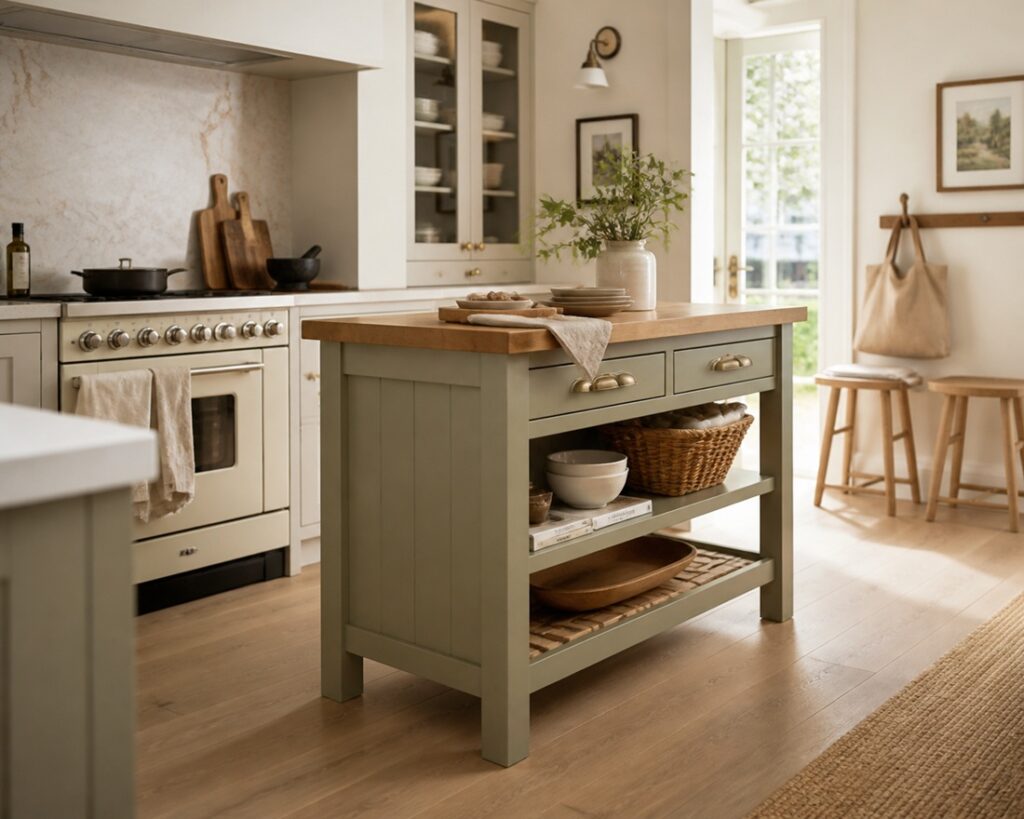
Unlike fitted or built-in cabinetry, freestanding cabinets are standalone pieces that are not permanently fixed to a kitchen wall or floor. They can often be moved more easily which makes them a flexible option for a wide range of homes.
Different types include:
- a standalone pantry cupboard on one wall
- a dresser or hutch for crockery and display storage
- a movable island or butcher’s block in the centre
- open shelving mixed with individual base cabinets
Visually, freestanding kitchens often feel more relaxed, decorative and less rigid than fully fitted kitchens. They are commonly associated with styles such as farmhouse, Hamptons, country and traditional kitchens.
That said, freestanding kitchens do not have to look old-fashioned. They can also be designed in a modern way with sleek finishes, minimalist units, and clean lines.
Why do people choose freestanding kitchen cabinets?
Freestanding cabinets appeal to buyers who want more design flexibility and a kitchen that feels less singular and more curated. They can soften the look of a kitchen and create a more customised feel.
Some people choose them because they like the style. Others appreciate the practicality of being able to update or rearrange individual pieces more easily over time. It’s also possible to put freestanding units on wheels, making it even easier to move around.
Here are some additional benefits.
Easier updates: If you want to refresh the look of your kitchen, it can be easier to swap out one piece rather than replacing an entire run of cabinetry.
Good for awkward spaces: In some homes, freestanding units can work well in rooms with uneven walls, unusual proportions, or architectural quirks.
Good for renters or temporary setups: In some cases, standalone kitchen pieces can be practical where a fully fitted kitchen is not possible or might cost too much to install.
What are the cons of freestanding cabinets?
Although freestanding cabinets have clear appeal, they are not the right choice for every kitchen. Here are some potential cons to consider.
Less seamless storage: Because the cabinets are not designed as one continuous fitted system, there may be gaps between units or unused areas. This can reduce storage efficiency compared with a fully fitted kitchen.
Cleaning can be harder: Spaces around and under freestanding units can collect dust, crumbs, and dirt more easily than built-in cabinetry.
Less integrated appearance: A freestanding kitchen can look mismatched or less polished than a fitted kitchen.
May not suit every layout: For compact kitchens, fitted cabinetry can sometimes make better use of every centimetre. There might not really be space for freestanding cabinetry to move around.
Appliance integration can be more difficult: Freestanding cabinetry may not work as neatly with integrated appliances.
Freestanding cabinets vs fitted cabinets
Whether freestanding cabinets are the right choice comes down to the balance between style, flexibility, and function. Unlike fitted kitchens, which are custom built as one continuous system, tailored to a room, freestanding kitchens are made up of individual furniture-style pieces.
Freestanding cabinets can be a great option if you want a kitchen with more personality, a softer decorative feel, and the flexibility to update or move pieces over time. They are especially well suited to country, farmhouse, traditional, and eclectic interiors. Fitted kitchens, on the other hand, are often better for maximising storage, achieving a sleek integrated appearance, fitting exact room dimensions, and concealing appliances neatly.
No matter your choice, WAP Prestige can help! We offer a wide range of kitchen cabinet designs that perfectly fit your home.