
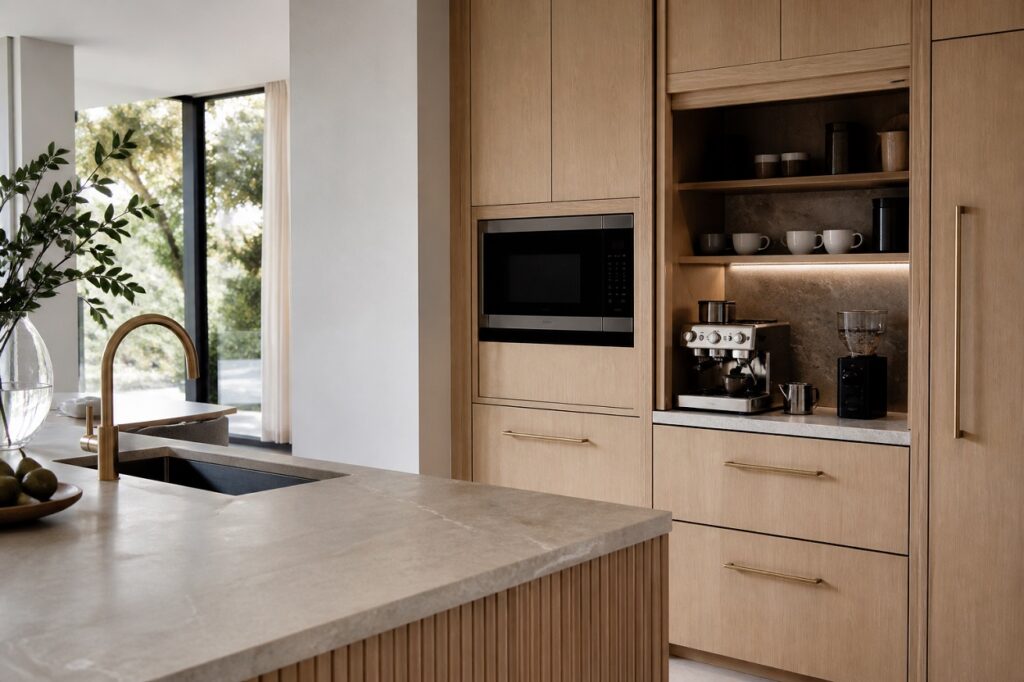
A microwave cabinet is a dedicated part of the kitchen designed to hold a microwave neatly, safely, and in a way that suits everyday use. It might be an open shelf for a freestanding unit, a cavity designed around a built-in model, or part of a concealed appliance zone near a breakfast station or coffee bar.
In Australia, the broad reference points for this kind of design are practical kitchen-planning principles, the NCC as the main construction code, AS/NZS 4386.2 for domestic kitchen assembly installation, and the manufacturer’s installation instructions for the exact appliance being used.
Where is the best place to put a microwave in the kitchen?
The best place for a microwave is usually somewhere that is easy to reach, close to the main prep area, and near enough to bench space that hot dishes can be set down safely. KBDi’s design criteria emphasise workable kitchen flow, adequate clearances, and suitable bench landing space on the handle side of appliances.
In practical terms, the most successful locations are often:
- in a tall cabinet at a comfortable height
- on an open shelf designed for a freestanding microwave
- in a built-in wall cabinet
- in a butler’s pantry or appliance garage
- beside or near a coffee bar, if power and ventilation have been planned properly
A microwave near a coffee station can work particularly well in custom kitchens because it keeps smaller appliances in one zone and reduces clutter on the main benchtop.
Can a countertop microwave be built into a cabinet?
Sometimes, but not automatically. A countertop microwave can only be built into cabinetry if that specific model is approved for that type of installation. For Sharp models, some may be used on a countertop, on a shelf, in a cabinet, or built in with a Sharp kit, but Sharp also warns not to block ventilation and not to use unapproved built-in kits.
That means a standard benchtop microwave should not simply be boxed into a cabinet to make it look built-in. If there is no approved trim kit or cabinet-installation method for that model, it should stay as a freestanding appliance with the clearances the manufacturer specifies.
Should a microwave cabinet have doors or not?
Either approach can work. An open microwave cabinet is usually the simplest option because it is easy to access and easier to ventilate. A cabinet with doors gives a cleaner, more integrated look and can suit higher-end custom kitchens, especially when paired with a coffee bar or appliance garage.
If doors are included, they need to be practical rather than purely decorative. The microwave still needs proper airflow and safe operation. That is especially important because Samsung Australia warns against installing a microwave behind a decorative door due to overheating risk.
Safety concerns
Is it okay to put a microwave in a cabinet?
Yes, but only if the microwave is suitable for that type of installation and the cabinet allows the ventilation and clearances required by the manufacturer. Not every microwave can be enclosed or installed under a cabinet, and a standard benchtop model should not simply be boxed in to create a built-in look.
Microwaves in cabinets need ventilation, although that usually means airflow space rather than external ducting. Australian manufacturer guidance from brands such as Samsung, Sharp, and Westinghouse makes it clear that ventilation openings must not be blocked, and some models are only suitable for cabinet installation when used with a specified trim kit or built-in system. If the product instructions do not clearly allow cabinet or under-cabinet installation, it should be treated as a freestanding appliance.
How do you make a regular microwave look built-in?
The best way is to use a model that is approved for built-in installation and pair it with the manufacturer’s trim kit or specified installation system. That gives the microwave a more integrated look and helps preserve the airflow path the appliance was designed to use.
Is there a common size for a microwave cabinet?
There is no single universal microwave cabinet size because the right dimensions depend on the appliance type, its ventilation needs, and whether it is freestanding or built in. That said, many Australian kitchens are designed around 600 mm modules.
Conclusion
A microwave cabinet should balance style, convenience, and safe installation. It can be open or concealed, freestanding or built-in, and can work well near a coffee bar if power, clearance, and ventilation are properly planned. As with any appliance integration, the final design should always align with the NCC, relevant AS/NZS requirements, and the manufacturer’s installation instructions.
If you’re planning a new kitchen or upgrading your current layout, custom cabinetry can help create a microwave cabinet that looks seamless, works for your routine, and suits the rest of your space. At WA Prestige Cabinets, we can design tailored kitchen storage solutions that combine practicality with a refined finish.
Contact us for more information at 08 9498 1880.